
【KAIWA】 Special Keynote Event by an External Expert
Share


March 16, 2026
We are pleased to report that special lecture event “KAIWA”, inviting external experts to our Wako office, was held for the purpose of acquiring diverse perspectives and knowledge on new fields.
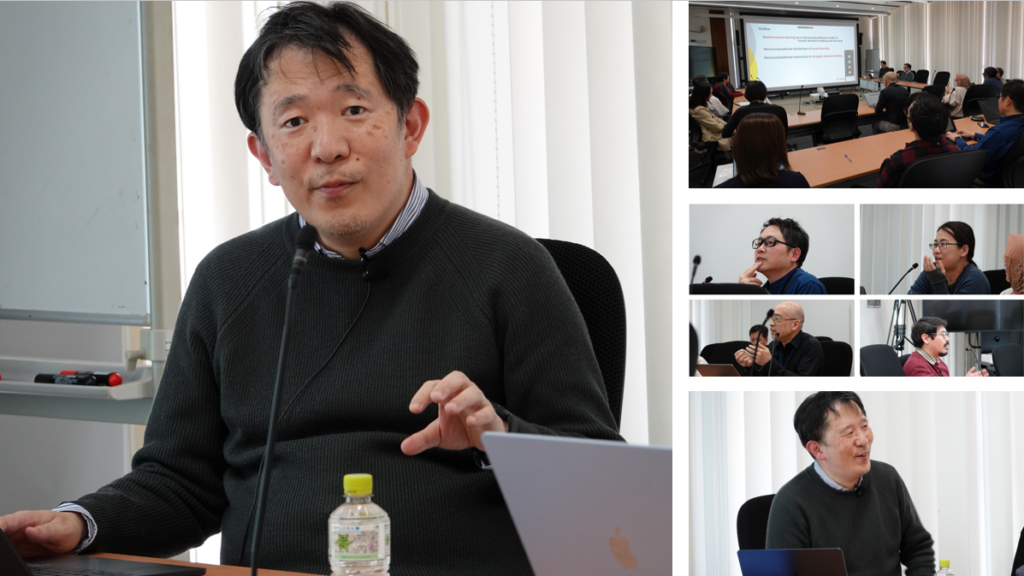
Guest speaker:
Name:Dr. Shinsuke Suzuki,
Affiliation: Professor, Faculty of Social Data Science, Hitotsubashi University
WEB: https://hri.ad.hit-u.ac.jp/html/100001640_profile_en.html
Title of the talk: "Neurocomputational mechanisms underlying human social decision-making.”
Abstract:
Humans routinely interact with others in group settings. Adaptive decision-making in social contexts is therefore crucial for survival. In this talk, I will present a series of studies examining the neurocomputational mechanisms underlying human social decision-making. First, I will show how people learn from others’ experiences. By combining functional Magnetic Resonance Imaging (fMRI) with computational modeling of behavior, we found that people rely on two learning systems implemented in distinct subregions of the prefrontal cortex (PFC): learning from others’ actions (imitation), associated with activity in the lateral PFC (lPFC), and learning from others’ outcomes (emulation), associated with activity in the ventromedial PFC (vmPFC). Moreover, individuals flexibly adjust these learning strategies as a function of others’ characteristics, accompanied by corresponding changes in lPFC activation patterns. Next, I will present our studies of strategic decision-making in groups. In a consensus-building task, we found that individuals’ behavior is driven by their own preferences, encoded in vmPFC, and by other group members’ past choices, represented in the temporoparietal junction (TPJ), as well as by inferences about others’ stubbornness, encoded in the inferior parietal lobule. Finally, I will demonstrate a causal role of TPJ in human strategic decision-making by integrating fMRI, behavioral modeling, and brain stimulation. Together, these findings elucidate how distributed brain regions interact to generate adaptive behavior in social situations.